 Court Reporting
Voicewriting Academy

Your Next Professional Chapter

Whatever brought you here, you're not starting from nothing. You're experienced, capable, and willing to work hard. What you want is a credible next step: a real skill, and a real credential to work toward.
But you've probably wondered…
does a new professional career really have to mean another four-year degree, more debt, and years of waiting before you can move forward?
There's nothing wrong with a degree. It just isn't the only route into every professional career.
Meet court reporting:
a profession many people have never considered.
When testimony and other spoken proceedings need to become an accurate written record, a court reporter is responsible for capturing what is said, word for word. Court reporters work in settings such as courtrooms and depositions, where that written record can become the official transcript of what occurred.
It's precise, skilled work that carries real professional responsibility, and it offers meaningful earning potential.
It's work that asks a lot of you, so how you prepare matters. Getting ready takes practice, feedback, and time. And it does not require another four-year degree.

But how does a court reporter capture every word? There is more than one method. CRVA trains students in voicewriting.
What is voicewriting? Here it is the CRVA way, in three layers:
You aren’t expected to know how to do this when you begin. That’s what the training is for.
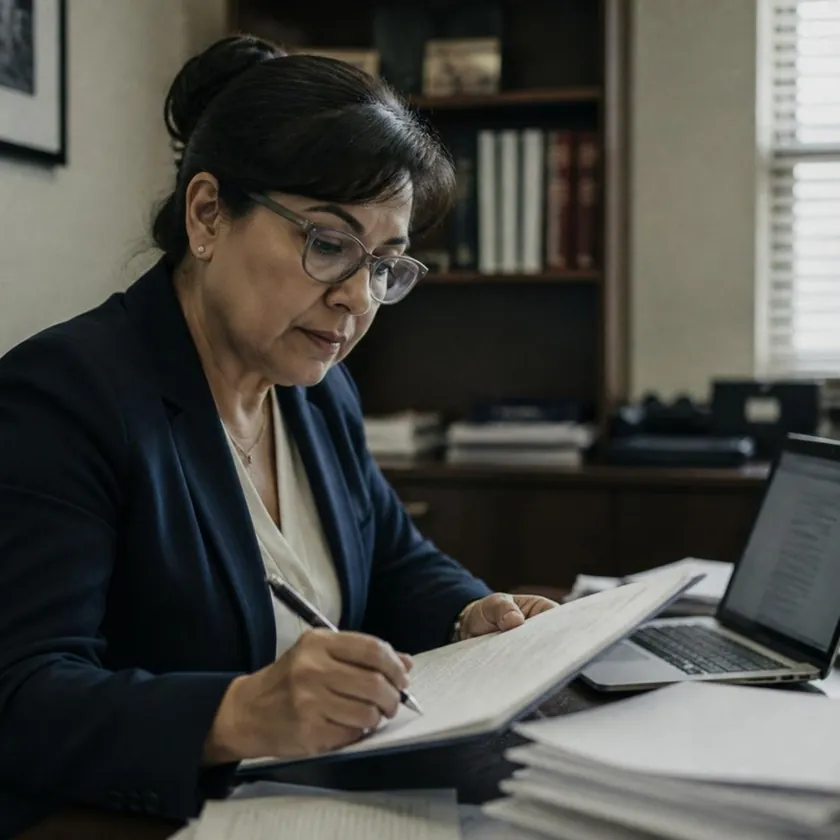
 ElleCRVA Founder
Texas Certified Shorthand Reporter (CSR)
Built from the program our Founder wished she had.
CRVA's Founder came to court reporting as an adult learner with a life already in motion. She also brought a background in journalism and corporate legal work, where working carefully with language, grammar, punctuation, proofreading, and written communication was already familiar territory.
But court reporting required her to build an entirely new professional skill set. While learning the profession, she was also navigating the realities of caregiving and periods when life interrupted her training.
Each time she returned, she wanted the same thing: a clear answer to Where did I leave off? What do I need to understand? What do I practice next?
So she created the structure she wished had been there from the beginning: organizing the material, studying it from multiple angles, practicing the skill, and continuing until she earned her Texas Certified Shorthand Reporter (CSR) credential.
That experience became the instructional foundation for CRVA: clear explanations, structured practice, defined progress, and fewer places for a student to be left guessing.
Whether you're changing careers, returning to work, or starting fresh,
the goal is the same: to feel truly ready.
A step-by-step path for developing
the knowledge and skills of the profession, while building toward Texas CSR certification readiness.
Online, self-paced, and mastery-based.
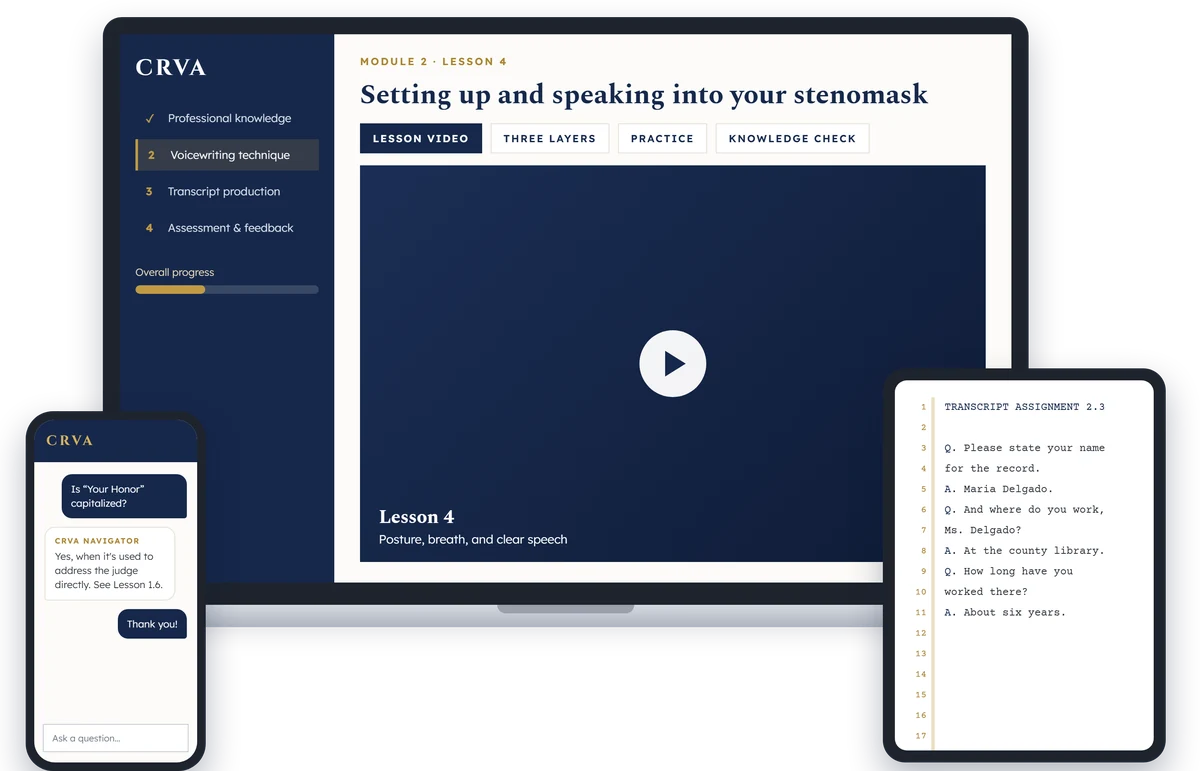
How CRVA Gets You Ready
Step one:
Know the profession. Court reporting fundamentals, ethics, grammar and punctuation, spelling and vocabulary, legal and medical terminology, and applicable Texas requirements, so you understand the standards before you're held to them.
Step two:
Develop your voicewriting skill. Learn voicewriting technique and build speed and accuracy through progressive dictation practice across the types of material used in court reporter skills training, including continuous spoken material (Literary), jury-charge material (Jury Charge), and question-and-answer testimony (Q&A).
Step three:
Produce a record you can stand behind. Transcript production and proofreading, applying the principles that govern the written record.
Step four:
Build readiness through mastery. Knowledge checks, assessments, and transcript assignments, with feedback, correction, remediation, and reassessment built into the learning process.

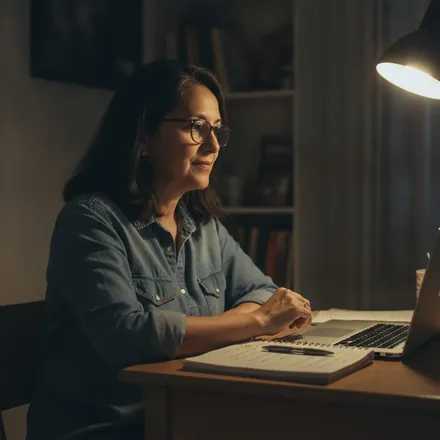



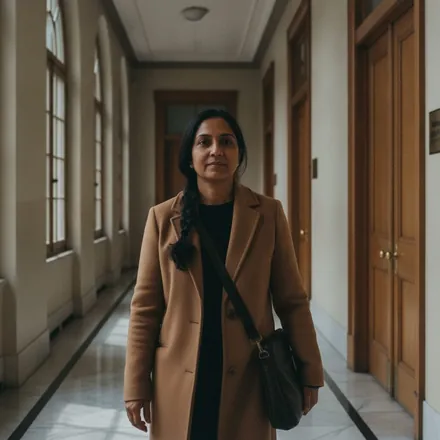
“If you're looking for a quick or easy path, this isn't it. If you're ready to build a real skill, we'll show you every step.”
A CRVA principleAnd the structure continues throughout your training:
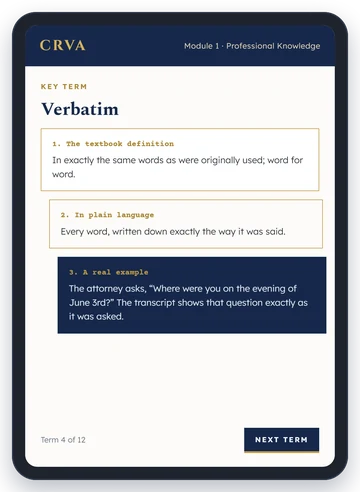
Three-layer teaching
Every concept arrives in three layers: the textbook definition, a plain-language definition, and a practical explanation with examples. So you don't just memorize it. You understand it, and you can use it.
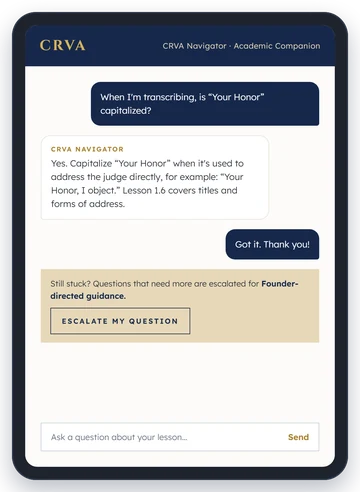
CRVA Navigator
Your Academic Companion for on-demand learning support with everyday questions, whenever you're studying. Questions that need more are escalated for Founder-directed guidance.
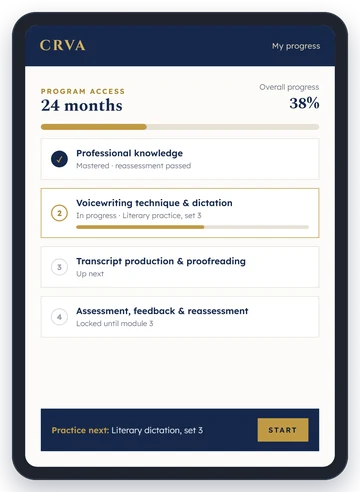
24 months of access
Up to 24 months of access, with progress and accountability support built into a clear learning sequence, so you always know what to practice next.
Let's find out!
CRVA is currently accepting applications.
We'd love to learn about your background and goals, and make sure CRVA is the right fit for you. You'll share a little about yourself, CRVA reviews your application, and then we'll set up a structured Admissions Conversation to answer your questions.

The CRVA Way comes straight from our Founder's own training, and from everything she wished had been done for her.
- Built around voicewriting. Our Founder learned court reporting through voicewriting and earned her Texas CSR. CRVA integrates voicewriting technique, stenomask practice, dictation, and the professional knowledge that supports the work.
- It's already organized. CRVA brings terminology, grammar and punctuation, Texas requirements, voicewriting practice, dictation, and transcript production into a structured learning sequence, so you can focus on learning instead of figuring out what comes next.
- Every concept, three ways. The textbook definition, a plain-language definition, and a practical example, so you understand it instead of just memorizing it.
- A clear next step. Each lesson spells out what to learn, how to practice it, and what comes next.
- Mastery, then momentum. You move forward when you've mastered a skill. Weak spots are corrected and reassessed before you build on them.
- Built for real life. The Founder built CRVA after experiencing firsthand how difficult it can be to resume training after life interrupts it. CRVA's clear sequence and progress tracking are designed to make it easier to see where you left off and what comes next.
Do I need a college degree?
No. CRVA does not require another four-year degree. Specific admissions requirements are reviewed during your application and Admissions Conversation.
I’ve never done anything like court reporting. Do I need prior experience?
No prior court reporting experience is expected. You aren’t expected to know how to do this when you begin. CRVA is built to teach it step by step.
What exactly is a Texas CSR?
CSR stands for Certified Shorthand Reporter, the name of the Texas court reporting credential. Despite the name, it doesn’t mean you have to learn stenography: Texas certifies court reporters who use voicewriting as well as those who use a stenotype machine. Certification requirements and exams are set by the Texas Judicial Branch Certification Commission.
Is CRVA live?
CRVA is online, prerecorded, and video-based, with a structured, self-paced sequence. You'll have on-demand learning support, feedback on assignments, and Founder-directed guidance for questions that need it.
How long does it take?
You'll have up to 24 months of access. Everyone progresses at a different pace, depending on practice and performance, so CRVA doesn't promise a completion timeline.
Voicewriting or stenography: what's the difference?
Both are methods used within the court reporting profession. Stenographers use a stenotype machine; voicewriters use a stenomask and speech-recognition software. CRVA focuses on voicewriting.
How much practice should I expect?
Court reporting is a skill built through consistent practice, not just watching lessons. The expected practice commitment is reviewed with you during your Admissions Conversation, so you can plan for it before you enroll.
Is equipment included?
Equipment and software are purchased separately. You'll get the details during your Admissions Conversation, so you know exactly what's needed before you enroll.
How does payment work?
Tuition and payment options, including any eligible third-party financing, are reviewed during your Admissions Conversation.
Where can court reporters work?
Court reporters work in settings such as courtrooms, depositions, and other proceedings where an accurate written record is needed. Work arrangements vary, including staff positions and freelance work.
What can court reporters earn?
Court reporting offers real earning potential, and compensation varies by setting, location, and type of work. CRVA doesn't promise any specific income or job placement.
Your next chapter can start with a skill you build now.
You bring years of experience. CRVA helps you add a new craft, one clear step at a time.